
BLUETTI at IFA 2026: Powering What’s Next
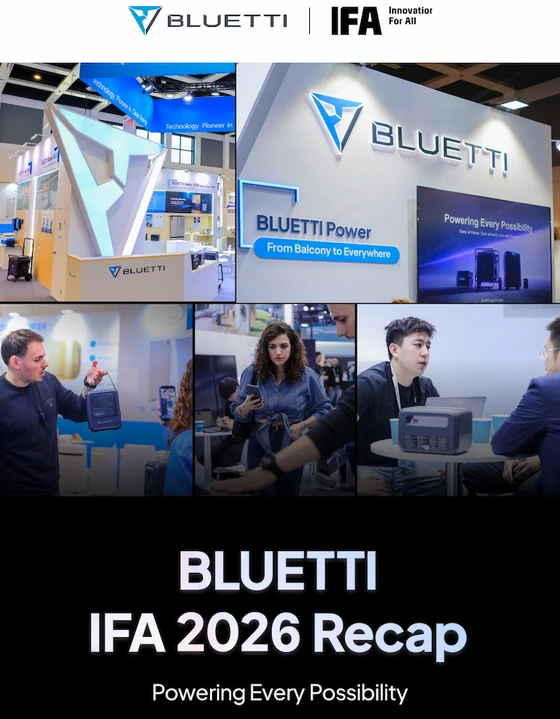
From Balcony Solar to a Complete Energy Ecosystem
One of the most important themes at IFA 2026 was the continued development of BLUETTI’s balcony solar strategy, an area that has become particularly relevant in Europe as consumers look for comparatively accessible ways to generate, store and intelligently consume their own electricity.
Rather than treating balcony photovoltaics as a small supplementary system intended only to offset a modest household base load, BLUETTI is progressively expanding the concept into a much broader home-energy architecture. Its Balco family integrates solar generation, battery storage, intelligent monitoring and automated energy distribution, while BLUETTI Space can interconnect multiple compatible units to create a distributed energy network.
The existing Balco 260 illustrates the modular philosophy particularly well, combining up to 2,400W of PV input with 2.56kWh of storage, four MPPT channels and a stackable expansion architecture that can reach 15.36kWh by adding BC260 battery modules. BLUETTI also emphasizes straightforward plug-and-play installation and its magnetic smart meter, intended to simplify monitoring and allow the system to respond more accurately to actual household consumption.
At IFA, however, the broader message was clear: balcony solar is becoming the entry point into something substantially larger.
Balco 500: Taking Plug-and-Play Solar Further
The Balco 500 was one of the central attractions of BLUETTI’s IFA presentation, bringing significantly greater storage and power capability to the company’s residential solar ecosystem.
With a 5,024Wh LFP battery, support for up to 4,600W of photovoltaic input and output reaching 3,680W, the Balco 500 moves beyond the traditional image of a small balcony battery designed primarily to handle refrigerators, routers and background household loads. It is conceived as a considerably more capable energy platform that can address appliances with much greater power requirements while retaining the accessibility associated with the Balco concept.
That combination is particularly interesting because the evolution of balcony solar is increasingly about reducing the distinction between a compact DIY photovoltaic installation and a more comprehensive residential energy-storage system. BLUETTI’s approach is to make that transition scalable rather than forcing users to replace their existing equipment as their energy requirements increase.
The wider industry appears to be moving in the same direction, with balcony and plug-in solar systems becoming a major theme at IFA 2026 and BLUETTI’s Balco 260 and Balco 500 appearing among the notable systems demonstrated at the show.
EnergyFlex: Making Portable Power Part of the Home
Perhaps one of the most strategically important concepts demonstrated by BLUETTI is EnergyFlex, described as a portable-to-grid energy system that effectively blurs the traditional boundary between a portable power station and residential storage.
The principle is compellingly straightforward. A compatible portable BLUETTI power station can be connected through the Balco Transfer Hub, allowing energy stored inside a device that might normally be used for camping, road trips or emergency backup to participate in the household energy system when it is sitting at home.
The Transfer Hub provides up to 800W of grid-tied output and 850W AC input, transforming compatible portable power stations into plug-and-play balcony solar components without requiring owners to replace their existing equipment. Compatibility extends across numerous BLUETTI models, while selected third-party power stations with suitable AC outputs can also be supported, although BLUETTI-specific intelligent functions depend on the hardware being used.
This is an important conceptual shift. Portable batteries spend a considerable amount of their lives stationary, and EnergyFlex attempts to make that stored capacity productive even when the power station is not travelling. A battery can contribute to household energy management during everyday use, then be disconnected and taken to a campsite, workshop, event or other location whenever portable energy is required.
BlueBot Brings AI into Home Energy Management
Artificial intelligence has inevitably become part of the modern smart-home conversation, but BLUETTI’s BlueBot is positioned around a particularly practical application: helping users understand and manage increasingly complicated household energy systems.
BlueBot operates as a home-energy assistant within BLUETTI’s AI-HEMS architecture, using information such as electricity pricing, photovoltaic generation forecasts, available energy sources and household consumption to help generate personalized energy strategies. Rather than expecting users to continually interpret graphs, tariff schedules, battery percentages and solar forecasts manually, the objective is to make interaction with the energy system considerably more conversational and accessible.
This becomes increasingly valuable as a home adds solar panels, multiple batteries, smart meters, controllable loads and dynamic electricity tariffs. Energy optimization is no longer simply a question of whether a battery is charged; it becomes a scheduling problem involving when electricity should be generated, stored, consumed or drawn from the grid.
BlueBot therefore represents the software layer of BLUETTI’s broader hardware strategy, attempting to make an increasingly sophisticated energy network feel less complicated to the person actually living with it.
Pioneer 5000: BLUETTI Goes to Work
IFA 2026 also demonstrated that BLUETTI is looking well beyond residential energy. The Pioneer 5000 represents a significant step into professional applications, presenting an E-Generator designed for demanding environments in which conventional fuel generators have traditionally been the obvious solution.
Unlike the relatively compact power stations associated with recreational use, Pioneer 5000 is purpose-built around mobility, substantial output and professional workloads, with its rugged wheeled frame immediately communicating that this is equipment intended to be moved around construction sites, workshops, maintenance operations, agricultural environments and other demanding locations.
The specifications reinforce that positioning. Pioneer 5000 delivers 5,000W of continuous output and can handle peaks of up to 18,000W, an especially significant characteristic when dealing with equipment such as pumps, compressors and electric motors that can require dramatically more power during startup than during normal operation. Its integrated LFP battery provides approximately 5.12kWh of capacity, with expansion taking the platform to around 35kWh, while high-voltage photovoltaic charging supports up to 4,000W of solar input.
This is therefore less a supersized camping battery and more an attempt to rethink the generator itself, replacing combustion, exhaust fumes and fuel handling with a rechargeable electrical architecture that can potentially incorporate solar generation as part of the working environment.
Portable Power Still Matters
Although BLUETTI’s IFA story increasingly revolves around integrated energy systems, the company has not abandoned the portable power category on which much of its reputation was built.
Its IFA showcase included the Elite family, ranging from compact models intended for lightweight mobile applications through substantially larger systems capable of supporting demanding appliances and backup scenarios. BLUETTI’s official IFA portfolio includes the Elite 30 V2, Elite 100 V2, Elite 200 V2, Elite 300 and Elite 400 alongside the new Elite Mini Series, illustrating how portable energy remains an important layer within the broader ecosystem rather than becoming a separate product category.
The crucial difference is that portability no longer necessarily means isolation. Through technologies such as EnergyFlex and the Transfer Hub, some of these batteries can potentially serve the home when they are not being used elsewhere, giving owners considerably greater utilization from hardware that would otherwise remain idle between trips or emergencies.
Award-Winning Innovation at IFA 2026
BLUETTI’s presence in Berlin also resulted in recognition across several parts of its new portfolio. According to the company’s IFA recap material, the Pioneer 5000 received an Innovation Award from 01net, FridgePower received a 2026 IFA Innovation Award, the Elite 300 was named Best in Show – IFA 2026 by Tom’s Hardware Italy, while the Transfer Hub received an Editors’ Choice Award from inside digital.
Those distinctions are notable because they cover very different product categories, from professional energy generation and portable power to specialized refrigeration backup and the infrastructure connecting portable storage with residential energy systems. Rather than highlighting a single flagship device, the awards reinforce the broader ecosystem strategy BLUETTI brought to Berlin.
Powering Every Possibility
What makes BLUETTI’s IFA 2026 presentation particularly interesting is not simply the number of new products on display, but the way those products increasingly connect with one another.
Balco provides the foundation for accessible residential solar generation and storage; EnergyFlex gives portable power stations a second role inside the home; the Transfer Hub creates a practical bridge between these previously separate categories; BlueBot and AI-HEMS provide the intelligence needed to coordinate increasingly complex energy flows; and Pioneer 5000 takes battery-based power into professional territory where fuel generators have traditionally dominated.
It represents a broader interpretation of what a modern energy company can provide. Instead of selling a battery for one specific scenario, BLUETTI is building toward an architecture in which stored energy can move conceptually between the balcony, household, vehicle, campsite and workplace, with hardware that becomes more useful because it is no longer restricted to a single purpose.
At IFA 2026, “Powering What’s Next” consequently felt like more than a convenient exhibition theme. BLUETTI’s latest portfolio suggests that the next stage of consumer energy will be defined not merely by larger batteries or higher inverter outputs, but by flexibility, interoperability and increasingly intelligent control — turning individual power products into a connected energy ecosystem designed to follow users wherever electricity is needed.
Did this article help you? If so, please tell me in a comment what do you think about it.
Don’t miss any of our future video tutorials, follow us on Youtube. Like us on Facebook. Join our Best Deals Telegram Channel. Join our Android TV Box Firmware Updates Telegram Channel. Subscribe now to our newsletter. If you need Tech Reviewer or Youtube Influencer read this. Donate now here to support CGR Team!















