Boya Notra Nano: Wearable AI Note-Taking Made Easy
Warning: Undefined array key "operator" in /home/r33217chin/public_html/wp-content/plugins/advanced-ads/classes/display-conditions.php on line 1372
Good ideas rarely wait for you to open a notebook. They emerge during conversations, between meetings, or in the middle of a busy day, when capturing every detail can distract you from the moment itself. The Boya Notra Nano approaches this familiar problem with a compact wearable design that combines voice recording with AI transcription, summaries, and searchable information. With shipping scheduled to begin on October 15, 2026, BOYA’s latest addition to its Notra family aims to make recording and revisiting everyday conversations a more natural habit.
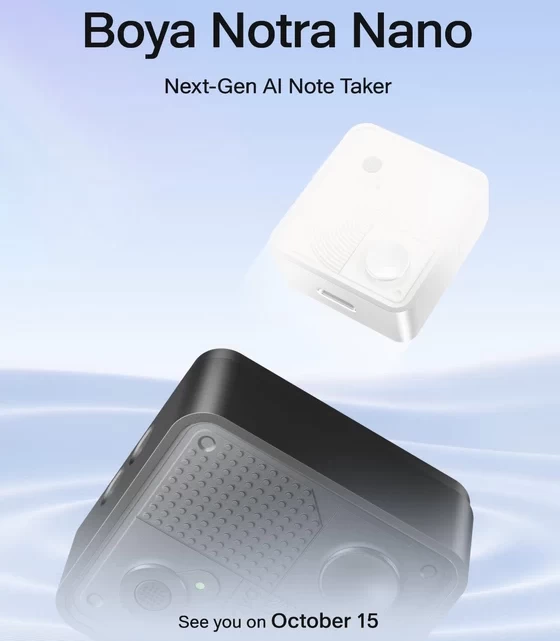
The wearable approach is central to its appeal. Supporting a lanyard, wristband, and magnetic attachment, the Notra Nano gives users three ways to keep the recorder close and accessible. That flexibility could prove useful throughout a varied working day, whether you are attending a presentation, interviewing someone, or capturing an idea while moving between appointments. Rather than requiring a dedicated place on a desk, the device can adapt to how and where you work.
Recording is designed to be similarly straightforward, with automatic switching between ambient and Bluetooth recording modes. Moving between face-to-face discussions and Bluetooth audio scenarios should therefore require fewer manual adjustments. BOYA also advertises clear voice pickup at distances of up to five meters, giving the Nano potential applications in meetings, study sessions, and small group conversations. Actual recording clarity will naturally depend on placement, background noise, and the surrounding space.
One of the more interesting features is the ability to add images, notes, and highlights while recording. Audio captures what people say, but it does not always preserve the context that makes a conversation meaningful. A photograph of a presentation slide, a brief written observation, or a highlighted moment can make the resulting record considerably more useful. For a technology journalist attending a product briefing, for example, connecting spoken explanations with relevant images could simplify the process of turning a session into an accurate article.
Once a recording is complete, AI transcription supports more than 140 languages, while smart speaker labeling helps distinguish contributions from different participants. This combination is particularly relevant to interviews, collaborative projects, and international discussions, where reviewing a readable transcript can be more efficient than repeatedly searching through an audio file.
The next step is organization. BOYA advertises AI summaries and mind maps alongside a selection of more than 60 professional templates, giving users different ways to turn recorded material into structured notes. A meeting recap, an interview outline, and a set of study notes serve different purposes, so having multiple presentation options could make the software useful across both professional and personal routines.
Ask AI adds a more direct way to explore recorded content. Users can ask questions to locate answers, identify key takeaways, and find source details within their recordings. The practical attraction is easy to understand: instead of replaying a lengthy discussion to recover one important point, you can search for the information you need through a conversational interface. For quotations or consequential decisions, checking the original recording remains a sensible final step.
Recordings can be accessed and managed through the Boya OS App and Web, with support for ten export formats. That makes the Nano’s workflow relevant beyond the device itself, allowing captured material to move into desktop editing, documentation, or sharing. BOYA advertises free unlimited cloud storage, although transcription allowances, template access, and Ask AI availability vary by plan; unlimited storage should not be confused with unlimited access to every AI feature.
The hardware specifications support the same everyday focus, with a stated recording duration of up to 16 hours, USB-C charging, and 8 GB of local storage. Together, these features suggest a device intended to remain available throughout a substantial day of conversations and activities, with local storage complementing its connected software services.
What makes the Boya Notra Nano worth watching is the way its features fit together. Wearable recording, added visual context, multilingual transcription, and AI-assisted retrieval all address different stages of the same task: capturing information and making it useful afterward. For students, journalists, creators, and professionals who regularly work with spoken information, that could make this small recorder a practical addition to their daily toolkit.
Did this article help you? If so, please tell me in a comment what do you think about it.
Don’t miss any of our future video tutorials, follow us on Youtube. Like us on Facebook. Join our Best Deals Telegram Channel. Join our Android TV Box Firmware Updates Telegram Channel. Subscribe now to our newsletter. If you need Tech Reviewer or Youtube Influencer read this. Donate now here to support CGR Team!