
DIGIERA OmniCore Launches on Kickstarter: 144TB of Flash Storage
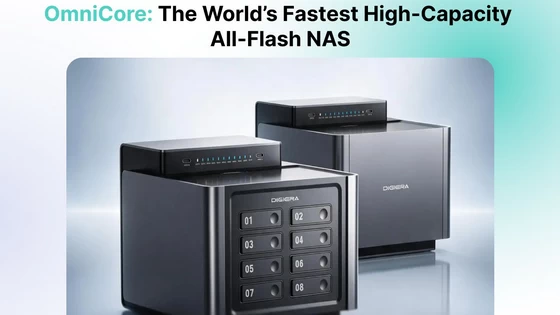
An All-Flash NAS Designed for Modern Creative Workflows
OmniCore is not simply a conventional NAS with a few SSD cache slots added to accelerate frequently accessed files. Its architecture is built around M.2 NVMe solid-state drives, allowing the system to avoid the mechanical latency, vibration and comparatively slow random-access performance associated with traditional hard-drive arrays.
DIGIERA claims performance of up to 14 times that of an HDD-based NAS, although real-world results will naturally depend on the selected drives, RAID configuration, network infrastructure, client hardware and type of workload. The practical objective is nevertheless easy to understand: large media projects should feel less like files stored on a distant archive and more like content located on a fast local workstation.
That distinction becomes particularly important when several demanding operations are taking place simultaneously. A video editor may be importing footage while another user accesses existing projects, the NAS creates previews in the background and an AI service indexes newly added material. On a traditional mechanical array, these concurrent requests can quickly expose the limitations of spinning disks, whereas an all-flash platform is considerably better suited to handling multiple random and sequential operations without making the entire workflow feel unresponsive.
For studios working with 4K and 8K material, photographers managing extensive RAW catalogues, production teams maintaining shared libraries or developers experimenting with locally hosted AI models, OmniCore is intended to become both the central repository and the computing platform supporting the content stored inside it.
Up to 144TB in a Single Flash-Based System
The headline specification is support for up to 144TB of flash storage, giving the upper OmniCore configurations enough potential capacity for substantial professional archives while retaining the responsiveness normally associated with NVMe SSDs.
It is important to understand that this figure represents supported maximum capacity rather than necessarily indicating that every reward tier includes 144TB of preinstalled storage. DIGIERA says OmniCore works with standard M.2 NVMe drives from multiple manufacturers, allowing owners to choose compatible SSDs according to their required capacity, endurance and budget rather than being permanently locked into a proprietary storage format.
This approach also creates a more flexible upgrade path. A studio can begin with the capacity it currently requires, populate additional bays as its archive grows and replace individual SSDs when larger or higher-endurance models become economically attractive. For professional users, this scalability may be almost as valuable as the headline maximum capacity, because storage requirements rarely remain static once higher-resolution cameras and more data-intensive production formats enter the workflow.
RAID support adds another essential layer for professional use, allowing multiple SSDs to be arranged according to the desired balance between usable capacity, performance and resilience. RAID should never be treated as a replacement for a separate backup, but it can protect workflow continuity when a drive fails and reduce the risk that a single hardware problem immediately interrupts an active production environment.
Up to 180 TOPS of Local AI Performance
Storage is only half of the OmniCore concept. The flagship Ultra configuration delivers up to 180 TOPS of AI computing performance and includes 64GB of LPDDR5 memory, positioning it closer to a compact AI workstation with integrated network storage than to a passive box used merely for holding files.
DIGIERA’s software platform is designed to run AI functions locally, enabling users to search, organise and analyse stored content without making cloud processing a mandatory part of the workflow. Natural-language search can help locate relevant files without depending exclusively on carefully maintained filenames and folder structures, while image recognition and OCR can identify scenes, objects, faces and visible text within extensive photo and video collections.
The more advanced configurations expand this idea with tools for local AI chat, transcription, document analysis, file organisation and creative assistance. Audio and video material can be converted into searchable text, documents can be summarised or examined, and stored media can be transformed into highlights, timelines or other generated outputs without requiring every source file to be uploaded to an external service.
Running these processes locally carries advantages beyond speed. Sensitive client footage, internal documents and personal photographs can remain on hardware controlled by the owner, reducing dependence on recurring cloud subscriptions and avoiding the need to transfer very large source libraries over an internet connection simply to make them searchable.
The 180 TOPS figure represents aggregate AI capability under supported workloads rather than a universal measure of application speed, but it clearly communicates the Ultra model’s intended role. This is not merely a NAS that happens to include an AI-labelled feature; it is being positioned as a self-contained platform for storage, media management, local model inference, automation and creative production.
Thunderbolt 4, 10GbE and 8K HDMI Connectivity
An extremely fast storage array is only valuable if its data can reach the devices using it, which is why the higher OmniCore configurations include Thunderbolt 4 and dual 10GbE connectivity alongside high-speed USB-C ports.
Thunderbolt 4 provides a direct, high-bandwidth connection for a nearby workstation, making OmniCore relevant for individual creators who want NAS functionality without accepting conventional network-transfer limitations. Dual 10GbE interfaces are better suited to shared production environments, where editors, colourists, designers and other collaborators may need simultaneous access to the same central media library.
The system can also output through 8K HDMI, reinforcing the idea that the Pro and Ultra variants can function as more than headless storage appliances. Depending on configuration and software requirements, OmniCore can become a compact desktop workstation, a local AI server, a media-management platform or the central storage engine for a small studio.
Three Configurations for Different Levels of Work
DIGIERA is offering OmniCore in Base, Pro and Ultra configurations, with each model addressing a progressively more demanding type of user.
The Base supports up to 56TB and is aimed at users who want the responsiveness of all-flash network storage together with core AI search and organisation features. It appears particularly suitable for personal media libraries, independent photographers, home studios and creators moving beyond slower entry-level NAS hardware.
The Pro increases maximum capacity to 144TB and introduces the broader local AI software suite together with faster connectivity for professional creative workflows. It is the most obvious middle ground for studios that primarily need high-capacity flash storage, rapid file access and practical on-device intelligence without necessarily requiring the Ultra model’s maximum AI computing capability.
At the top of the range, the 144TB-capable Ultra combines 64GB of LPDDR5 memory with up to 180 TOPS of AI performance, making it the configuration most clearly positioned as an AI creative workstation. Its target audience extends beyond conventional NAS users to include developers, AI enthusiasts, production teams and professionals interested in local inference, virtual machines, containers and computationally intensive content-management tasks.
Kickstarter Super Early Bird Pricing
The 56TB-capable OmniCore Base is available through the Super Early Bird tier for $799, representing a $300 reduction from its planned $1,099 retail price. The 144TB-capable Pro is offered for $1,499, saving $700 compared with the stated $2,199 MSRP, while the flagship Ultra is priced at $2,199, an $800 saving from its planned $2,999 retail price.
DIGIERA is also offering a Full Pack priced at $1,789, combining the OmniCore Pro with a magnetic portable SSD and a 2TB PCIe Gen 4 NVMe drive. With a claimed 43% reduction, this represents the deepest percentage discount of the campaign and provides a more complete package for creators who want both centralised storage and a portable drive for capturing or transporting active projects.
Every promotional tier is limited in quantity, while shipping is not included in the pledge price and will be collected after the campaign through the post-campaign backer survey. The Base is scheduled to begin shipping in December 2026, followed by the Pro and Ultra in January 2027.
The campaign has already moved well beyond its original $50,000 funding target and has received Kickstarter’s “Project We Love” designation, reflecting strong early interest in a product that attempts to bring high-capacity NVMe storage and local AI processing together inside one system. As with any crowdfunded hardware project, however, specifications, production schedules and delivery dates can still change before fulfilment, so prospective backers should examine the campaign details and associated risks carefully.
A NAS That Wants to Become the Centre of the Studio
DIGIERA OmniCore arrives at a moment when creative files are becoming larger, AI workflows are becoming more common and cloud storage is not always fast, affordable or private enough for professional production. By combining an all-flash architecture, support for up to 144TB, RAID functionality, Thunderbolt 4, dual 10GbE, 8K HDMI and as much as 180 TOPS of local AI performance, OmniCore proposes a considerably broader role than that of an ordinary network storage enclosure.
Its appeal is especially clear for users whose computers are already fast enough but whose projects remain constrained by slow storage, fragmented media libraries or cloud-dependent AI tools. If DIGIERA can translate its ambitious specifications into stable hardware, polished software and sustained real-world performance, OmniCore could become a particularly interesting central platform for video production, photography, collaborative media management and private AI computing.
Did this article help you? If so, please tell me in a comment what do you think about it.
Don’t miss any of our future video tutorials, follow us on Youtube. Like us on Facebook. Join our Best Deals Telegram Channel. Join our Android TV Box Firmware Updates Telegram Channel. Subscribe now to our newsletter. If you need Tech Reviewer or Youtube Influencer read this. Donate now here to support CGR Team!















