
GMKtec vs Mac Mini: Stop Paying for AI. Run It Locally
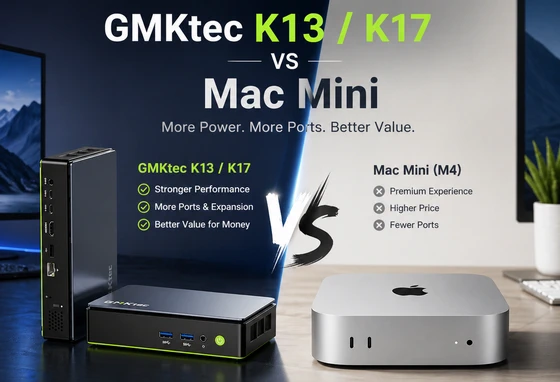
Apple’s Mac Mini remains a refined piece of engineering. Its tight integration between macOS and Apple Silicon delivers a polished, predictable experience that works exceptionally well for general productivity, creative workflows, and users deeply embedded in the Apple ecosystem. It’s quiet, efficient, and stable. But that same controlled ecosystem comes with trade-offs—especially when workloads move beyond traditional tasks into AI inference, local model execution, and hardware-level customization.
This is where the GMKtec K13 and K17 fundamentally reposition the conversation. Instead of relying on cloud-based AI services—with their recurring costs, latency overhead, and inherent privacy exposure—these systems are built to execute AI workloads locally. With an integrated NPU delivering up to 115 TOPS of compute, the K13/K17 enables real-time inference directly on the device. Large language models like Llama 3, Qwen, or GLM can run offline, unlocking AI-assisted writing, coding, image generation, and even video workflows without a persistent internet dependency. The implication is significant: zero subscriptions, zero data leakage risk, and full operational control.
Despite this capability, the physical footprint remains aggressively compact. At roughly 0.6 liters, the K13/K17 occupies less space than most networking hardware, yet it delivers multi-display output configurations up to 8K and maintains low power draw in the ~37W range. This makes it viable not just for personal desks, but for always-on deployments—whether in enterprise environments, development labs, or edge computing scenarios where efficiency and uptime matter.
The architectural difference becomes even more pronounced when you examine expansion. The Mac Mini, by design, is a closed system. What you buy is what you keep. In contrast, the GMKtec platform embraces modularity. Dual M.2 slots allow storage scaling up to 16TB, USB4 provides high-bandwidth connectivity for external devices, and in the case of the K17, OCuLink support introduces the possibility of external GPU integration—effectively transforming a compact mini PC into a scalable workstation. Networking is equally robust, with WiFi 6E and multi-gigabit LAN enabling high-throughput data operations across local and distributed environments.
This flexibility extends into use-case versatility. The K13/K17 is not confined to a single role. It can operate as a workstation, a local AI server, a NAS, a media center, or a hybrid development node. That level of adaptability is critical in a landscape where workloads evolve rapidly and hardware needs to keep pace without requiring full system replacement.
What ultimately defines the difference is forward compatibility. The GMKtec K13/K17 isn’t just built for today’s applications—it’s architected for the next three to five years of AI-driven computing. With LPDDR5X memory, high-throughput I/O, and dedicated AI acceleration, it is positioned to handle increasingly complex models and workflows as they become standard.
The Mac Mini remains an excellent choice for users prioritizing ecosystem cohesion and simplicity. But if your workflow is shifting toward local AI execution, hardware-level flexibility, and long-term value optimization, then the equation changes. The GMKtec K13 and K17 are not just alternatives—they are purpose-built systems for a decentralized, AI-first future where performance, privacy, and control are no longer negotiable.
Did this article help you? If so, please tell me in a comment what do you think about it.
Don’t miss any of our future video tutorials, follow us on Youtube. Like us on Facebook. Join our Best Deals Telegram Channel. Join our Android TV Box Firmware Updates Telegram Channel. Subscribe now to our newsletter. If you need Tech Reviewer or Youtube Influencer read this. Donate now here to support CGR Team!















