
RayNeo Air 4 Pro with the World’s First Custom Vision 4000 Chip
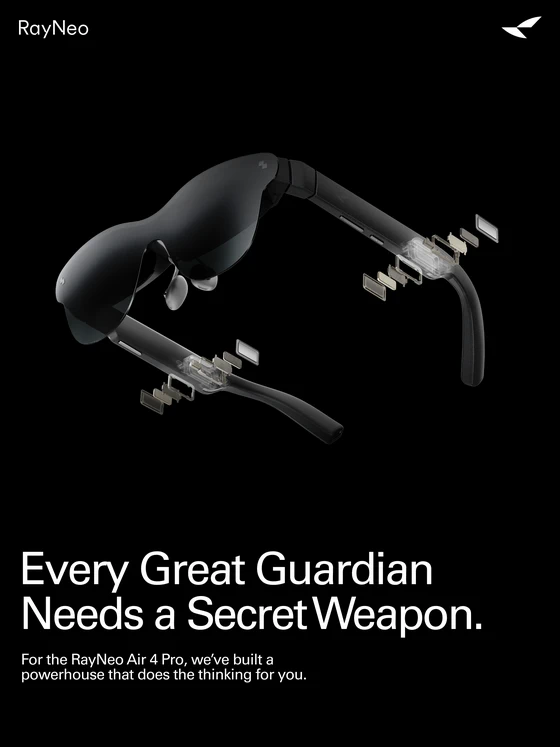
Most display wearables live and die by the source device—whatever your phone/handheld outputs is what you get, warts included. Air 4 Pro adds a dedicated Pixelworks Vision 4000 processor (co-developed with RayNeo, per RayNeo-focused coverage) to enhance the signal with tone mapping, white balance, and contrast enhancement before it’s shown on the micro‑OLED panels. That matters because it targets the exact pain point of portable big‑screen viewing: mixed-quality content. RayNeo explicitly leans on two “watch-anything” tricks enabled by Vision 4000—SDR‑to‑HDR upscaling and 2D‑to‑3D conversion—so the glasses aren’t only impressive with perfect HDR masters; they’re designed to make the typical feed look richer, deeper, and more immersive.
HDR10 done the hard way
“Supports HDR” is easy to say and hard to feel—especially on compact optics where brightness, contrast, and color depth have to align. Air 4 Pro is marketed in the press as the first HDR10-enabled AR glasses, combining HDR10 support with 10-bit color output (for smoother gradients) rather than standard 8-bit pipelines used by many displays. The rest of the stack is built to back up that claim: dual 0.6-inch Micro‑OLED displays with up to 120Hz refresh rate, peak brightness up to 1,200 nits, and 3,840Hz PWM hybrid dimming aimed at comfortable viewing over longer sessions.
A “big screen” you can pack
RayNeo’s pitch isn’t mixed reality overlays—it’s the feeling of a large screen anywhere. Reported specs frame the virtual canvas as up to a 201-inch screen at about 6 meters viewing distance, paired with a very high stated contrast ratio (200,000:1) and multi-step brightness adjustment for different environments. For the audience that actually buys these—travelers, commuters, handheld-console owners, laptop nomads—the killer feature is consistency. The Vision 4000 approach is essentially a promise that your content won’t look flat just because the source is average or the scene is dark.
Audio and comfort: the unglamorous essentials
RayNeo also positions Air 4 Pro as “smart audio glasses,” and multiple outlets note a four-speaker setup tuned in collaboration with Bang & Olufsen. Weight is reported at 76g, with comfort touches like adjustable nose pads mentioned in coverage—small details that decide whether “personal cinema” is a 20-minute demo or a two-hour habit.
Editorial take
Air 4 Pro’s most important shift is philosophical: it treats image quality as a system problem, not just a panel spec. By putting a dedicated image-quality chip between your device and your eyes—and pairing it with HDR10, high refresh, and high-frequency dimming—RayNeo is betting that the future of display wearables is less about adding reality, and more about rescuing it from mediocrity.
Did this article help you? If so, please tell me in a comment what do you think about it.
Don’t miss any of our future video tutorials, follow us on Youtube. Like us on Facebook. Join our Best Deals Telegram Channel. Join our Android TV Box Firmware Updates Telegram Channel. Subscribe now to our newsletter. If you need Tech Reviewer or Youtube Influencer read this. Donate now here to support CGR Team!















