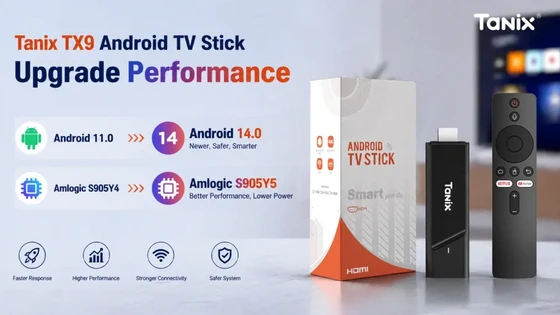
Tanix TX9 TV Dongle Upgrade: Android 14 & Amlogic S905Y5
From a manufacturing perspective, Shenzhen Oranth Technology Development Co., Ltd. continues to optimize the Tanix product portfolio for OEM and ODM partners looking for stable Android TV hardware with long product lifecycle support.
The original Tanix TX9 Android TV Stick established a solid foundation for compact streaming applications, and the upgraded model continues that design approach with improved hardware efficiency and software support.
S905Y5 vs S905Y4 Performance Comparison
The transition from S905Y4 to S905Y5 introduces a move from Quad-core Cortex-A35 to Quad-core Cortex-A55 architecture. While both chipsets are designed for compact Android TV and TV dongle products, the newer platform improves processing efficiency and sustained workload performance.
This change is not simply about increasing benchmark scores. In many streaming environments, TV dongles often operate for long periods without interruption, making architecture efficiency and thermal control more important than short-term peak performance.
| Category | S905Y4 | S905Y5 | Practical Effect |
|---|---|---|---|
| CPU Architecture | Quad-core Cortex-A35 | Quad-core Cortex-A55 | Improved multitasking efficiency |
| Streaming Stability | Stable | More consistent during sustained workloads | Smoother playback experience |
| Power Management | Standard scaling | Optimized power control | Reduced heat generation |
| Media Processing | 4K H.265 / VP9 | Improved media pipeline efficiency | Better compatibility with modern streaming applications |
| System Response | Stable | Faster task scheduling | Improved interface responsiveness |
From a system integration perspective, these improvements become more noticeable during long runtime sessions where multiple applications and services operate simultaneously.
Android 14 System Improvements
The move from Android 11 to Android 14 brings changes that affect system behavior more than visual appearance.- TV dongles and compact streaming devices frequently run multiple background services at the same time, including streaming applications, middleware, and system-level tasks. Android 14 improves background process handling and memory allocation efficiency, helping reduce performance drops during extended operation.
In practical streaming scenarios, these improvements can contribute to:
– Faster application response after long runtime sessions
– Reduced lag during content switching
– Improved multitasking behavior
– Better support for newer application frameworks
– More stable long-term system performance
The evolution of Android platforms in TV hardware is becoming increasingly important as software support cycles continue changing, a trend explored in Android system trends in TV box manufacturing.
For commercial streaming projects, newer Android versions also help extend application compatibility windows and reduce long-term maintenance requirements.
Streaming Performance in Real Use Cases
Long runtime behavior often reveals limitations that benchmark tests cannot measure. In one hospitality integration project, engineering teams using older Android 11 streaming devices reported slower interface response and increasing system lag after long operating periods. Devices installed in enclosed spaces behind televisions also experienced heat buildup after extended playback sessions. After moving to S905Y5 with Android 14, engineers observed more consistent performance during continuous use. The updated platform delivered smoother navigation, fewer playback interruptions, and more stable operation throughout long runtime cycles. The most noticeable improvement was not raw speed but consistency over time. For hospitality environments and managed streaming systems, predictable long-term behavior often matters more than benchmark numbers.
Bluetooth Voice Remote Upgrade
The updated TX9 replaces traditional infrared control with Bluetooth voice interaction. In real installations, this creates greater flexibility because users no longer need direct line-of-sight access when operating the TV dongle. This becomes especially useful in hotel environments or setups where streaming devices are installed behind televisions. Voice input also improves content search efficiency in TV dongle and streaming applications, particularly when users navigate larger content libraries. For system integrators, Bluetooth control can simplify installation planning and reduce device placement limitations.
Product Upgrade Continuity
The upgraded TX9 maintains the familiar product structure while improving the underlying hardware and software architecture. This continuity creates a smoother transition path for distributors and Android TV hardware partners already using previous TX9 versions. Existing product strategies can evolve without requiring major changes to hardware planning or software ecosystems. Maintaining form factor consistency while improving internal efficiency is especially valuable for projects that depend on stable supply chains and predictable upgrade cycles.
Why This Upgrade Matters for Buyers
For OEM customers, distributors, and Android TV hardware partners, the value of a TV dongle upgrade extends beyond specifications. The updated TX9 introduces practical improvements that directly affect lifecycle management and operational efficiency:
– Longer software support with Android 14
– Improved stability during continuous streaming sessions
– Better compatibility with modern streaming applications
– Reduced maintenance requirements
– Stable hardware for OEM customization projects
– Improved performance consistency during long runtime operation
As Android ecosystems continue evolving, these improvements become increasingly relevant for businesses planning long-term product strategies.
Discuss Your Android TV Project Requirements
Whether you are sourcing TV dongles for hospitality projects, expanding regional distribution channels, or developing a branded Android TV product line, the upgraded TX9 TV dongle provides a scalable platform designed for long-term planning.
Customization options include:
– Firmware customization
– Logo branding
– Packaging design
– UI modification
– Bulk production support.
OEM and ODM services are available for partners requiring flexible hardware solutions and large-volume supply support.
Did this article help you? If so, please tell me in a comment what do you think about it.
Don’t miss any of our future video tutorials, follow us on Youtube. Like us on Facebook. Join our Best Deals Telegram Channel. Join our Android TV Box Firmware Updates Telegram Channel. Subscribe now to our newsletter. If you need Tech Reviewer or Youtube Influencer read this. Donate now here to support CGR Team!