The Contenders at a Glance
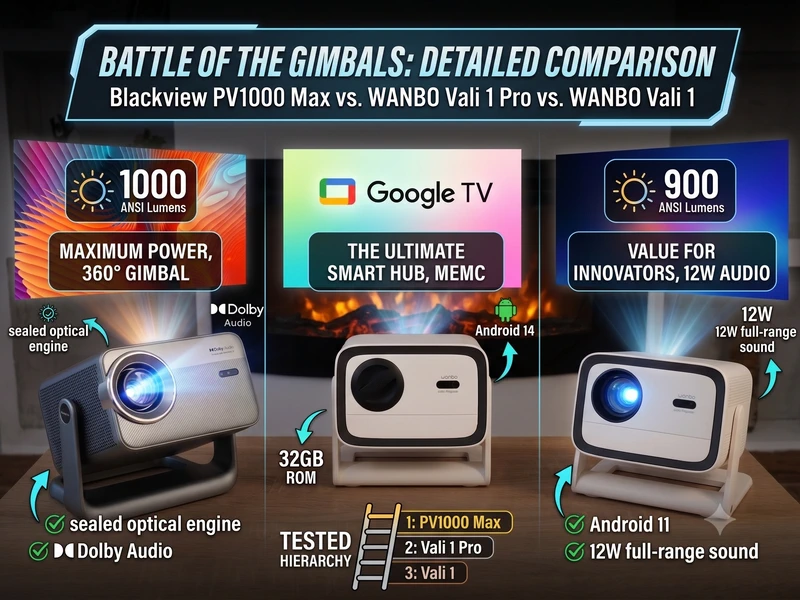
Blackview PV1000 Max: The bright powerhouse running the ultra-fluid VIDAA OS, boosting real-world output up to 1000 ANSI Lumens with a premium 360° rotating gimbal.
Wanbo Vali 1 Pro: The modern, design-forward flagship utilizing a 200° mechanical gimbal, packed with an officially licensed Google TV platform (Android 14) and premium MEMC motion handling.
Wanbo Vali 1: The sci-fi-inspired pioneer that started the Vali lineup, sporting a sleek “EVE-like” shape, 200° gimbal, and Android TV 11 ecosystem.
1. Design, Build, and Mechanical Freedom
– Blackview PV1000 Max: Weighing roughly 3.5kg, this unit feels incredibly rugged and premium, utilizing metallic accents rather than cheap plastics. It features a full 360-degree rotating gimbal that lets you point the lens absolutely anywhere—from the opposite wall straight up to the ceiling—with immaculate balance and zero drift.
– Wanbo Vali 1 Pro & Vali 1: Both Wanbo models feature a distinct, minimalist approach weighing 2.8kg. The original Vali 1 draws clear sci-fi inspiration (resembling EVE from WALL-E), while the Pro refines it into a gorgeous beige, modern lifestyle aesthetic. Their 200-degree gimbals are excellently tuned, providing smooth, reliable adjustments. A clever design bonus here is the bracket-integrated power interface, meaning cables won’t tangle when you pivot the projector toward the ceiling.
2. Brightness & Optical Performance
– Blackview PV1000 Max: This is the brightest projector of the trio at 1000 ANSI Lumens. Backed by an enclosed dust-proof optical engine (boasting a 20,000+ hour life), it punches through ambient lighting surprisingly well. While dark rooms offer the ultimate cinematic depth, the PV1000 Max remains genuinely watchable during daytime hours with partially drawn curtains.
– Wanbo Vali 1 Pro & Vali 1: Both projectors punch out 900 ANSI Lumens. While the original Vali 1 performed admirably in controlled environments, the Vali 1 Pro takes a massive leap forward visually by introducing an advanced MediaTek processor, HDR10 mapping, and crucially, MEMC Motion Smoothing. MEMC drastically minimizes blur during high-speed gaming or action-packed sports broadcasts—a feature completely absent on the base Vali 1.
3. Ecosystem & Smart Interface
– Wanbo Vali 1 Pro (The Ecosystem Winner): The Pro completely shines here by featuring officially licensed Google TV (Android 14) with native Netflix certification right out of the box. Supported by 2GB RAM and 32GB ROM, navigating the massive catalog of 10,000+ apps is seamless, ultra-responsive, and lag-free.
– Blackview PV1000 Max: Blackview took a unique path by choosing the official VIDAA OS over Android. Powered by an MT9660 quad-core chip, the UI performance is incredibly snappy and entirely free of intrusive boot-up ads. It effortlessly loads certified streaming platforms (Netflix, Prime Video, Disney+) and even local apps like Digi TV or Focus+. Controlling it via the dedicated VIDAA mobile app turns your smartphone into a flawless remote control.
– Wanbo Vali 1: The classic model runs on Android TV 11 backed by a SkyWorth Leap-L1 internal TV stick architecture (1GB RAM / 8GB ROM). While it holds Widevine L1 certification for HD playback across major apps, the hardware is noticeably more modest compared to the robust chipsets driving the newer Max and Pro variations.
4. Audio Quality
– Wanbo Vali 1 Pro & Vali 1: Wanbo dominates the pure acoustic space with a massive 12W full-range stereo setup backed by a large 500cc sound chamber and DSP digital amplification. The audio is incredibly rich, throwing deep bass response and balanced mids across a standard living room.
– Blackview PV1000 Max: Features dual 6W stereo speakers certified by Dolby Audio. While it lacks the sheer physical cavity volume of the Wanbo, its virtual surround-sound processing handles spoken dialogue sharply and accurately. It also includes a dedicated Bluetooth Speaker Mode, transforming the machine into a standalone music player when the projection lens is off.
Head-to-Head Comparative Chart
| Feature | Blackview PV1000 Max | Wanbo Vali 1 Pro | Wanbo Vali 1 |
| Brightness | 1000 ANSI Lumens | 900 ANSI Lumens | 900 ANSI Lumens |
| Gimbal Range | 360° Rotation | 200° Tilt | 200° Tilt |
| Operating System | VIDAA OS | Google TV (Android 14) | Android TV 11 |
| Memory / Storage | Fluid Core Architecture | 2GB RAM / 32GB ROM | 1GB RAM / 8GB ROM |
| Motion Smoothing | Standard | MEMC Supported | No |
| Audio Power | 12W (2 x 6W) Dolby Audio | 12W Full-Range / 500cc Chamber | 12W Full-Range / 500cc Chamber |
| Smart Calibration | 6-in-1 TOF Intelligent | ASA 3.0 Intelligent | ASA 3.0 Intelligent |
| Netflix Certification | Yes | Yes | Yes (Widevine L1) |
| Noise Level | ≤30 dB | ≤28 dB | ≤28 dB |
Performance Hierarchy & Final Verdict
Based on weeks of testing gaming controllers, streaming 4K clips, and evaluating daytime/nighttime viewing, here is my definitive structural hierarchy:
1st Place (The Ultimate Premium All-Rounder): Blackview PV1000 Max. If your primary concern is raw projection performance, the Blackview PV1000 Max takes the crown. The combination of 1000 ANSI lumens, a completely uninhibited 360° mechanical gimbal, dust-sealed optics, and the fast, ad-free VIDAA OS makes it the most flexible and robust home theater alternative. It excels anywhere from living rooms to outdoor campsites.
2nd Place (The Smartest Software & Media Hub): Wanbo Vali 1 Pro. If you want the cleanest, most modern software experience, the Wanbo Vali 1 Pro is your ideal choice. The addition of MEMC motion tracking, double the internal storage (32GB), and an elegant native Google TV OS interface makes it feel precisely like a premium smart television trapped inside an incredibly stylish, flexible body.
3rd Place (The Budget-Friendly Innovator): Wanbo Vali 1. The original Wanbo Vali 1 remains a phenomenal choice if you are hunting for value or adore its distinct, sci-fi physical design. While it loses out on the generational performance leaps (like Android 14, expanded RAM, and MEMC processing found in the Pro), it still brings 900 ANSI Lumens, an intelligent auto-calibration suite, and excellent 12W chambered audio to the table at an accessible tier.
Did this article help you? If so, please tell me in a comment what do you think about it.
Don’t miss any of our future video tutorials, follow us on Youtube. Like us on Facebook. Join our Best Deals Telegram Channel. Join our Android TV Box Firmware Updates Telegram Channel. Subscribe now to our newsletter. If you need Tech Reviewer or Youtube Influencer read this. Donate now here to support CGR Team!