
The History and Future of Software Development
No matter your role in modern-day society, software likely plays a significant part in your day-to-day activities—whether that is through your work as a software developer, or simply because you use the self-service checkout at your local supermarket.
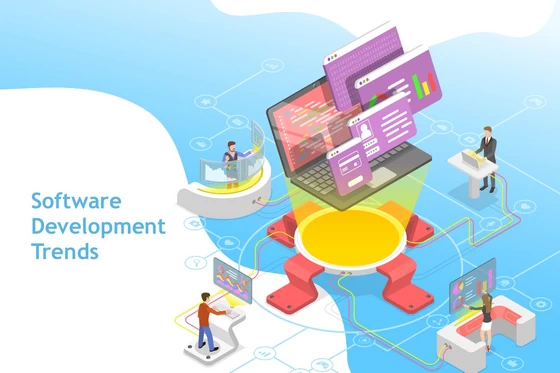
Every computer-like device relies on software to provide the functions that we all take for granted—on the surface level, we are met with sleek, stylish, and ergonomic interfaces that enhance our capabilities to complete tasks, while underneath, there are complex mechanisms to ensure that all functionality operates as it should.
Of course, this wasn’t always the case—only recently has technology improved and advanced to the point that it permeates most areas of our lives; and it has been a process many decades in the making to get to a point where software can be utilized in the way that it currently is.
Technology hasn’t stopped advancing though—much the opposite, as it continues to exponentially improve in scope and capability, meaning that for those in tech and software development, the potential is somewhat limitless when looking forward to the future.
Read on to find out more about the history of software development, and where the industry will take software going forward.
Humble beginnings
The first example of software ever being created was in 1948, some years before many would expect—and it was this event that saw the birth of a new age, as people realized the immense potential of this technology.
Tom Kilburn was a computer scientist from England, and it was him that produced the Manchester Small-Scale Experiment Machine, also known as “Baby.” With this creation, he had built software that could make calculations based on data and code instructions, with the machine taking 52 minutes to calculate the greatest divisor of 2 to the power of 18.
This seems like child’s play considering that most of us had access to highly capable calculators when we were in school, but for the time, it was revolutionary.
Widespread integration
With the rise of early personal computing devices in the late 1970s and 1980s, software began to be used in very specific settings, with programming languages written for Apple’s Apple II device, which could provide spreadsheet functionality.
However, it had very little application for the vast majority of people, and accessibility was low. It only made sense in settings where large finances and scaling were available for very specific processes.
Throughout the 1990s and the 2000s, technology continued to improve and with it, the capabilities of software to complete more advanced and more relevant tasks.
The future is here
Today, software is all around us, and software development plays a critical role in the running of society at all levels. Most people are used to using one aspect of software or another, while software development is looking at a limitless future with cloud computing.
Using platforms such as Amazon’s AWS and Microsoft’s Azure, and employing the services of an AWS certified solutions architect, software developers can create platforms of incredible capability, and tailor software to be highly optimized for an individual user.
Software development is here to stay and will continue at a rapid pace. Future generations will no doubt consider the technological advances that we are making today to be outdated and inadequate in comparison to what will eventually be available to them.
Did this article help you? If so, please tell me in a comment what do you think about it.
Don’t miss any of our future video tutorials, follow us on Youtube. Like us on Facebook. Join our Best Deals Telegram Channel. Join our Android TV Box Firmware Updates Telegram Channel. Subscribe now to our newsletter.














