
Elecrow CrowPi 3: A Portable AI Lab for the Next Generation of Innovators
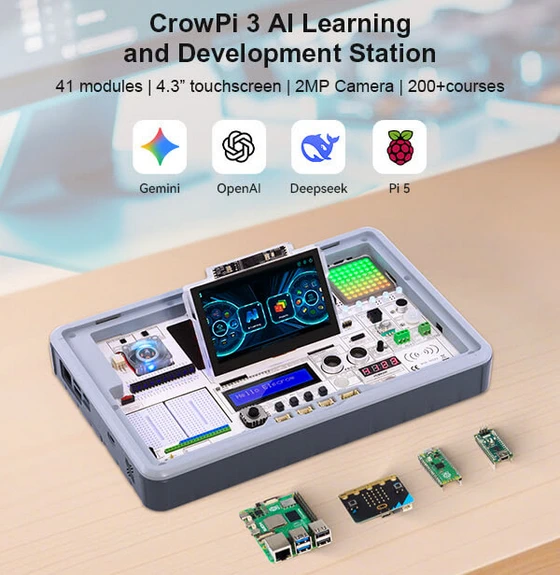
At its core, the CrowPi 3 is a compact, self-contained development environment that merges hardware experimentation with artificial intelligence capabilities. Housed in a portable case that resembles a miniature engineering workstation, the system integrates a wide variety of sensors, modules, and interactive components, allowing users to explore electronics and AI concepts without the complexity traditionally associated with prototyping hardware. Instead of dealing with tangled wires and separate modules scattered across a desk, the CrowPi 3 provides a structured and ready-to-use platform where experimentation can begin immediately.
One of the defining characteristics of the CrowPi 3 is its remarkable hardware versatility. The platform supports several of the most widely used development boards in education and maker communities, including Raspberry Pi 5, Arduino Nano, micro:bit, and Raspberry Pi Pico. This compatibility makes the device exceptionally flexible, allowing users to explore different programming ecosystems within the same environment. A beginner might begin by experimenting with Arduino-based sensor control, gradually moving into Python programming and more advanced AI workloads powered by Raspberry Pi. Instead of replacing development kits as skills grow, the CrowPi 3 evolves with the user, supporting increasingly complex projects as knowledge expands.
What makes the CrowPi 3 particularly impressive is the large number of integrated modules embedded directly into the platform. The system contains 41 built-in modules, including more than thirty sensors and interactive components that cover a wide spectrum of hardware experimentation. The device features a 4.3-inch capacitive touchscreen, providing an intuitive interface for interacting with projects, monitoring sensor data, or navigating learning materials. A 2-megapixel camera enables visual recognition experiments and computer vision projects, while the high-sensitivity microphone opens the door to voice interaction and audio processing applications.
Because these modules are integrated into the development station, users no longer need to assemble complex circuits before testing an idea. Sensors, displays, and input components are already connected and ready to interact with code. This design dramatically reduces setup time while simultaneously eliminating many of the frustrating wiring errors that beginners often encounter. The result is a learning experience that emphasizes creativity and problem-solving rather than troubleshooting hardware connections.
When combined with the processing power of Raspberry Pi 5, the CrowPi 3 becomes an impressive platform for experimenting with edge-based artificial intelligence. Developers can implement computer vision algorithms using OpenCV, explore facial detection and tracking systems, or build projects capable of recognizing objects and gestures in real time. The inclusion of camera and audio hardware allows developers to explore human-machine interaction in ways that feel tangible and engaging.
Beyond computer vision, the CrowPi 3 also opens the door to experimenting with local large language models (LLMs) and AI inference running directly on the device. This ability reflects a broader shift in artificial intelligence development, where many applications are moving from cloud-based systems toward edge computing environments. Running AI models locally allows developers to explore privacy-preserving AI systems, offline interaction tools, and responsive embedded intelligence capable of functioning without continuous internet connectivity.
The integration of visual sensors, audio input, and programmable modules enables a fascinating range of interactive AI projects. A developer might create a face-recognition access system that unlocks a door when a known face is detected, or build a voice-controlled smart device capable of responding to spoken commands. Gesture recognition projects can allow users to control LEDs, displays, or robotic systems through simple hand movements detected by the camera. Environmental sensors can be combined with machine learning algorithms to create intelligent monitoring systems capable of reacting to changes in temperature, light, or motion.
These types of projects demonstrate one of the most important aspects of the CrowPi 3: its ability to bridge the gap between digital algorithms and the physical world. Instead of writing code that only produces output on a screen, developers can build systems that see, hear, detect, and respond to their surroundings. This tangible interaction makes complex technological concepts easier to understand while simultaneously making experimentation more engaging.
Equally important is the extensive learning ecosystem built around the CrowPi 3. Elecrow provides access to more than 200 educational courses and guided tutorials, covering topics that range from basic programming concepts to advanced AI development. The curriculum includes lessons on Python programming, sensor control, hardware interaction, and machine vision. By combining theoretical explanations with hands-on projects, the learning materials allow users to develop practical engineering skills step by step.
For students and beginners, this structured approach reduces the intimidation often associated with electronics and artificial intelligence. Instead of trying to piece together information from scattered tutorials across the internet, learners can follow a clear progression from introductory exercises toward more advanced projects. More experienced developers can also benefit from the platform by using it as a rapid prototyping environment for experimenting with new AI concepts or testing embedded hardware ideas.
The portability of the CrowPi 3 further enhances its appeal. Unlike traditional lab setups that require multiple devices and dedicated workspace, the CrowPi 3 is built as a compact all-in-one system that can be transported easily. Its protective case keeps all components organized and secure, making it suitable for classroom environments, workshops, research labs, or live demonstrations. Within seconds, the device can transform any table into a fully equipped AI experimentation station.
This portability also makes the CrowPi 3 particularly valuable in educational contexts where flexibility is important. Teachers can bring the device directly into classrooms to demonstrate real-world AI applications, while students can carry the system between home and school without dismantling their projects. For makers and hobbyists, the device functions as a mobile development workstation that can be used anywhere inspiration strikes.
As artificial intelligence continues to shape the future of technology, tools that make AI accessible to newcomers will play an increasingly important role in education and innovation. The Elecrow CrowPi 3 succeeds in this mission by combining hardware experimentation, AI development, and structured learning into a single platform that encourages exploration and creativity.
Rather than being simply another electronics kit, the CrowPi 3 represents a complete ecosystem designed to help users understand how intelligent systems interact with the physical world. By bringing together sensors, computing power, machine learning capabilities, and guided education, it transforms abstract technological concepts into practical experiences that anyone can explore.
For students, educators, and makers interested in stepping into the world of artificial intelligence and embedded systems, the CrowPi 3 offers something genuinely valuable: a portable laboratory where ideas can quickly become working intelligent machines.
Did this article help you? If so, please tell me in a comment what do you think about it.
Don’t miss any of our future video tutorials, follow us on Youtube. Like us on Facebook. Join our Best Deals Telegram Channel. Join our Android TV Box Firmware Updates Telegram Channel. Subscribe now to our newsletter. If you need Tech Reviewer or Youtube Influencer read this. Donate now here to support CGR Team!















