
CrowView Note 14” Turns Arduino UNO Q into a AI Development Workstation
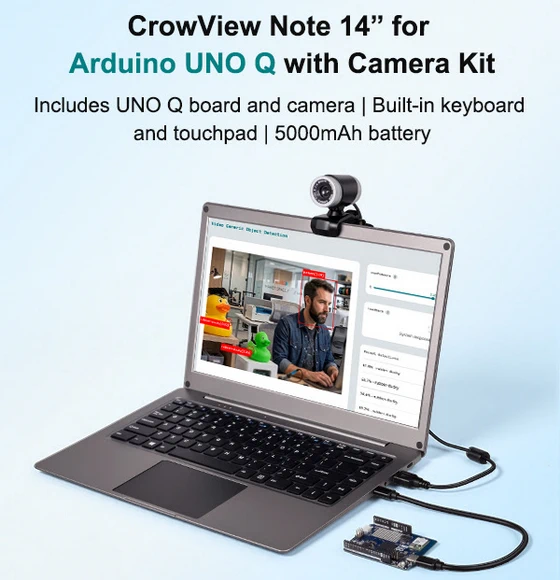
At the core of this experience is simplicity. With a single full-featured USB Type-C connection, the CrowView Note instantly turns the Arduino UNO Q into a complete development notebook. Power delivery, display output, keyboard and touchpad input, audio, and even camera data all flow through one cable. There’s no setup overhead, no cable clutter, and no friction—just connect and start building. It’s a level of plug-and-play integration that feels closer to modern consumer devices than traditional dev boards.
Under the hood, the UNO Q introduces a powerful hybrid architecture that bridges high-level computing with real-time control. The combination of a Qualcomm Dragonwing QRB2210 MPU and an STM32U585 MCU allows the system to run Linux Debian while maintaining precise hardware responsiveness. This dual-core design enables developers to handle complex AI workloads alongside low-level embedded tasks without compromise, opening the door to more advanced, edge-driven applications.
What elevates the platform further is its built-in AI acceleration. With a quad-core 2.0GHz CPU, Adreno GPU, and dual ISPs, the CrowView Note isn’t just a development interface—it’s a capable edge AI machine. Local object detection, gesture recognition, and computer vision processing can run directly on the device, reducing dependency on cloud services and enabling faster, more secure deployments. For developers working on robotics, smart devices, or vision-based systems, this is a significant advantage.
The hardware experience matches the performance. The 14-inch IPS display delivers Full HD resolution with 100% sRGB coverage, ensuring clarity and color accuracy whether you’re coding, debugging, or visualizing data streams. The 180-degree hinge adds flexibility, making it easy to adapt the device to different working environments, from lab benches to field testing scenarios.
Mobility is not an afterthought here. The integrated 5000mAh battery provides up to a few hours of untethered development, allowing real work to happen outside of traditional setups. Even more practical is the reverse charging capability, turning the CrowView Note into a power source for other devices when needed—a small but thoughtful addition that reinforces its role as a true portable workstation.
Compatibility extends beyond the Arduino ecosystem, making this device more than a niche tool. Support for platforms like Raspberry Pi 5, Jetson Nano, smartphones, and even gaming consoles means the CrowView Note can serve as a universal interface for a wide range of development and testing scenarios. It’s a flexible hub for makers, engineers, and AI developers alike.
The CrowView Note 14” isn’t just another accessory—it’s a shift in how embedded systems are developed and deployed. By merging portability, AI capability, and seamless integration into a single device, it removes many of the traditional barriers between idea and execution. For developers looking to build smarter, faster, and more freely, this is a compelling step forward
Did this article help you? If so, please tell me in a comment what do you think about it.
Don’t miss any of our future video tutorials, follow us on Youtube. Like us on Facebook. Join our Best Deals Telegram Channel. Join our Android TV Box Firmware Updates Telegram Channel. Subscribe now to our newsletter. If you need Tech Reviewer or Youtube Influencer read this. Donate now here to support CGR Team!















