
RayNeo Air 4 Pro Buying Guide 2026: Who Should (and Shouldn’t) Buy

What Sets the Air 4 Pro Apart
Most augmented reality smart glasses under $500 ship with standard dynamic range panels and basic speakers. The Air 4 Pro takes a different path, pairing HDR10 with a dedicated chip, co-tuned audio, and a battery-free 76-gram frame.
HDR10: A First for Display Glasses
The display uses a SeeYa 0.6-inch Micro-OLED panel at 1920×1080 per eye with a 200,000:1 contrast ratio and 98% DCI-P3 coverage. RayNeo markets it as the world’s first HDR10 AR display — a claim also reported by Android Authority during CES 2026 coverage. No other best smart glasses 2026 competitor ships HDR10 under $450.
The Vision 4000 Chip
Co-developed with Pixelworks, this processor handles real-time SDR-to-HDR upscaling and AI-driven 2D-to-3D conversion for compatible local video content. Its HDR10 pipeline supports 10-bit color depth, commonly described as over one billion displayable colors. RayNeo claims ΔE < 2 color accuracy, a strong figure for consumer display glasses.
Audio Co-Tuned by Bang & Olufsen
Four directional speakers deliver 360-degree spatial sound with acoustic tuning by Bang & Olufsen. A whisper mode cuts leakage for public transit and flights. The optional Sound Tube directs audio into the ear canal for louder, more focused output in noisy environments.
76 Grams, No Internal Battery
The frame weighs 76 grams with a 46.7:53.3 front-to-rear ratio designed to reduce nose bridge pressure. There is no built-in battery — power draws from the connected device via USB-C, keeping the frame lighter but draining your source faster. Among augmented reality smart glasses in this class, setup stays minimal.
Who Should Buy the Air 4 Pro
Three buyer profiles extract the most value from the Air 4 Pro. If your use case falls into any of the groups below, it likely outperforms other augmented reality smart glasses in this price range — especially for screen-first tasks.
Frequent Flyers and Commuters
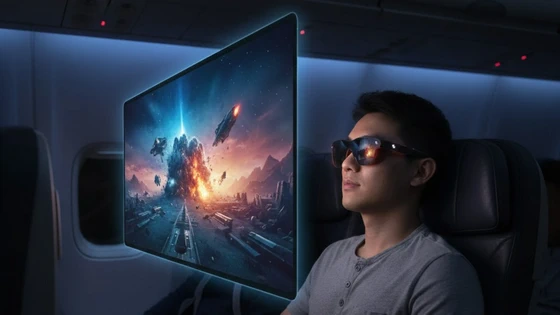
Connect an iPhone 15 or later via USB-C and the Air 4 Pro delivers a 201-inch equivalent virtual screen at optimal viewing distance. At 76 grams, it adds less carry-on weight than over-ear headphones. HDR10 sharpens dark cabin viewing where standard augmented reality smart glasses wash out.
Handheld and Console Gamers
Steam Deck and many USB-C DP handhelds work through a single cable with the 120Hz display and HDR10 support. HDMI-first consoles such as PS5 may require a compatible adapter. For gamers evaluating the best smart glasses 2026 under $300, that broad device compatibility stands out against pricier alternatives.
Prescription Lens Users
A magnetic prescription frame supports up to −10.00 diopters of myopia and +8.00 of hyperopia. No stacking daily glasses underneath. Among best smart glasses 2026 display models, vision correction options vary: XREAL offers a prescription lens accessory, while Viture uses a built-in myopia dial.
Who Should Not Buy
The Air 4 Pro handles specific tasks well but does not attempt to cover every use case. Not all best smart glasses 2026 buyers need a display-first device, and those with different priorities will find stronger options elsewhere.
Content Creators and AI-First Users
There is no camera, no onboard AI, and no social media pipeline. Users wanting hands-free video capture or voice-driven search should consider the Ray-Ban Meta Gen 2, which starts at $379 with a 12MP camera and Meta AI in a lighter frame. These augmented reality smart glasses prioritize viewing, not content creation.
Outdoor and Standalone Users
Peak brightness reaches 1,200 nits — adequate indoors but not enough for direct sunlight. Augmented reality smart glasses designed for outdoor use, like the RayNeo X3 Pro at 6,000 nits, exist but at $1,299 serve a different budget. The Air 4 Pro also requires a connected source device at all times.
How the Air 4 Pro Stacks Up
Context shapes buying decisions more than raw specs alone. The table below maps the Air 4 Pro against three products that best smart glasses 2026 shoppers cross-compare most often when evaluating display-class augmented reality smart glasses in a similar price band.
| Spec | RayNeo Air 4 Pro | XREAL 1S | Viture Pro XR | Ray-Ban Meta Gen 2 |
| Price | $299 | $449 | ~$459 | from $379 |
| Category | Display glasses | Display glasses | Display glasses | AI / camera glasses |
| Weight | 76g | 82g | 77g | ~49g |
| Display | 1080p/eye Micro-OLED, HDR10 | 1200p/eye Sony Micro-OLED | 1080p/eye Micro-OLED | No display |
| Virtual Screen | 201 in. | 500 in. | 135 in. | N/A |
| Refresh Rate | 120Hz | 120Hz | 120Hz | N/A |
| Audio | B&O co-tuned | Bose speakers | Harman tuned | Open-ear |
| Vision Correction | Magnetic Rx frame | Rx lens accessory | Built-in dial (~−5.0D) | Rx lens options |
| HDR10 | √ | × | × | N/A |
| Camera / AI | × | × | × | √ 12MP, Meta AI |
Where the Air 4 Pro Wins
Among best smart glasses 2026 display models under $300, it is the only option pairing HDR10 with a magnetic prescription frame. The XREAL 1S projects a larger virtual screen but costs $150 more and ships without HDR. The Viture Pro XR starts at roughly $459 and needs a separate dock for Switch.
Where Rivals Have the Edge
The XREAL 1S delivers a wider 52-degree field of view for buyers who prioritize screen coverage over HDR color depth. The Ray-Ban Meta Gen 2 occupies a different product category altogether — no display, but a 12MP camera, Meta AI, and multi-hour battery in a frame that passes as regular sunglasses.
What to Know Before You Order
HDR10 playback depends on source content, host-device output, cable, and app support. Full 10-bit output works with iPhone 15 and later, recent Macs, Windows PCs with HDR capability, and PS5 via HDMI adapter. On some Android devices, HDR behavior may vary; the Vision 4000 chip applies SDR-to-HDR upscaling to help close the gap. Current RayNeo product pages emphasize a 201-inch virtual-screen experience at a specified viewing distance. Some earlier spec materials reference a 135-inch image-size figure. Treat these as measurement-context differences rather than a fixed physical screen size.
The Bottom Line
The Air 4 Pro does not replace AI smart glasses or VR headsets. It replaces the screen you carry. At $299, it is one of the strongest value picks among best smart glasses 2026 contenders for display-first buyers, especially where HDR video and travel viewing matter most.
Did this article help you? If so, please tell me in a comment what do you think about it.
Don’t miss any of our future video tutorials, follow us on Youtube. Like us on Facebook. Join our Best Deals Telegram Channel. Join our Android TV Box Firmware Updates Telegram Channel. Subscribe now to our newsletter. If you need Tech Reviewer or Youtube Influencer read this. Donate now here to support CGR Team!















