
Meet LinknLink at IFA Berlin 2026
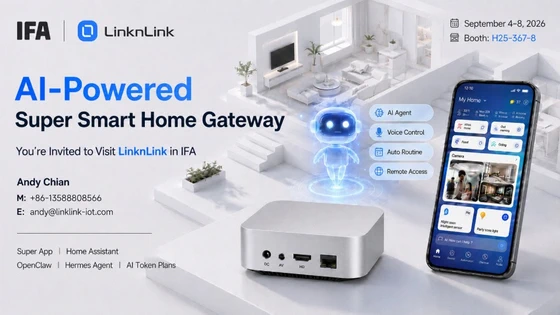
From Smart Home Gateway to AI Home Agent
One of the most interesting aspects of LinknLink’s IFA presentation is the emphasis on an AI Agent rather than conventional rule-based automation alone. Traditional smart homes are extremely capable when their owner knows exactly what should happen and when: if a sensor detects movement, turn on a light; if the temperature crosses a threshold, activate climate control; at a particular hour, close the blinds. These routines remain useful, but artificial intelligence creates an opportunity to move beyond rigid “if this, then that” behavior toward a system capable of interpreting more natural requests and coordinating several connected functions as part of the same interaction.
LinknLink’s Super Smart Home Gateway is being presented as the physical and computational foundation for that experience, bringing together AI Agent functionality, voice control, automatic routines and remote access within a unified smart-home environment. The concept is particularly compelling when considered alongside Home Assistant, one of the most flexible platforms available for users who want considerably more control over their connected devices than a conventional closed ecosystem normally provides.
The result is a vision in which the gateway does not simply relay commands between a smartphone and a light bulb, but becomes an intelligent orchestration point for the home, capable of connecting multiple devices and services while providing a more conversational way to control them.
AI Meets Home Assistant
Home Assistant integration is arguably one of the most significant elements of LinknLink’s IFA 2026 strategy because it immediately places the platform within a much broader smart-home environment. Enthusiasts increasingly expect interoperability rather than being locked into a single manufacturer’s catalogue, and an open approach provides considerably greater freedom when building sophisticated automations involving lighting, environmental sensors, security devices, climate systems, switches and other connected hardware.
LinknLink’s presentation suggests an architecture intended to combine this openness with a much simpler interaction model. Instead of requiring every member of a household to understand dashboards, entities, triggers and automation logic, an AI layer can potentially translate ordinary requests into meaningful actions while Home Assistant continues to provide the underlying device and automation infrastructure.
This distinction is important because the future of smart-home AI is unlikely to be defined simply by putting a chatbot on another screen. Its real value emerges when natural-language intelligence can interact with the physical environment, understand available devices and execute coordinated actions without requiring the user to navigate several applications or manually construct every routine.
Voice Control That Goes Beyond Simple Commands
Voice control has been part of the connected-home landscape for years, but most implementations have traditionally revolved around relatively simple commands. LinknLink’s AI-oriented approach points toward something more sophisticated, where voice becomes an interface for an intelligent home agent rather than merely a replacement for tapping a button.
In practical terms, this could make smart-home interaction feel considerably more natural. A capable AI agent can interpret intent, understand relationships between devices and potentially coordinate several actions from a single request, while automatically generated routines could reduce the amount of configuration normally required to make a sophisticated smart home genuinely useful.
LinknLink is also highlighting remote access, an essential component for anyone who wants to monitor or manage the home while travelling or simply check its status from elsewhere. Bringing remote connectivity, automation and AI-assisted control together under the same architecture could help eliminate some of the fragmentation that still characterizes today’s smart-home market.
One Super App for the Connected Home
Another major component of LinknLink’s strategy is its Super App concept, which aims to provide a central interface for interacting with the connected environment. The company’s IFA material shows a dashboard capable of presenting different rooms, connected appliances, environmental information, cameras, intelligent sensors and lighting controls within a single mobile experience.
This approach becomes especially valuable as the number of smart devices increases. A household containing only a few connected lights can comfortably survive with separate applications, but once cameras, thermostats, sensors, switches, appliances and automation systems are introduced, application fragmentation quickly becomes inconvenient. A consolidated interface, particularly one enhanced by an AI agent capable of understanding natural requests, has the potential to make a large smart-home installation feel much less complicated from the user’s perspective.
LinknLink is also highlighting OpenClaw, Hermes Agent and AI Token Plans as elements of its wider platform strategy, reinforcing the impression that the company is developing more than another standalone smart-home hub. The objective appears to be an extensible AI ecosystem in which hardware, software, intelligent agents and automation can work together as parts of the same connected architecture.
An Open Approach Could Be the Most Important Part
The word “open” is particularly important when discussing the next generation of smart-home technology. Consumers have accumulated devices from many different manufacturers over the past decade, and expecting them to replace perfectly functional hardware simply to participate in another proprietary ecosystem is increasingly difficult to justify. The strongest smart-home platforms are therefore likely to be those capable of acting as an intelligent layer across existing devices rather than demanding that every component originate from the same brand.
By placing Home Assistant alongside its own AI technologies, LinknLink is addressing precisely this requirement. The combination offers an interesting proposition for both mainstream consumers and advanced enthusiasts: sophisticated automation underneath, but potentially much simpler AI-assisted interaction on top.
That balance could ultimately determine how useful artificial intelligence becomes inside the home. Powerful automation systems already exist, but their flexibility often comes with additional complexity. AI has the potential to bridge that gap, making advanced automation accessible through ordinary language while preserving the interoperability and customization demanded by experienced smart-home users.
Meet LinknLink at IFA Berlin 2026
For anyone attending IFA Berlin this year, LinknLink’s booth should be an interesting destination, particularly for visitors following the convergence of artificial intelligence, Home Assistant and next-generation home automation. The company will be exhibiting from September 4 through September 8, 2026 at Booth H25-367-8, with its team available to demonstrate the latest AI + Home Assistant solutions and discuss the direction in which the platform is developing.
LinknLink is also inviting partners, creators and smart-home enthusiasts to meet the team in person, exchange ideas and explore potential future collaborations. Visitors invited by the company can also stop by to receive a LinknLink product and a special token prepared for the occasion, adding a more personal touch to what is already shaping up to be an interesting demonstration of AI-powered home technology.
The company’s on-site representative is Mr. Andy Chian, who will be available during the exhibition for discussions and demonstrations.
As smart homes move beyond simple connected switches and predefined routines, the more important question is becoming how all of those devices can work together intelligently without making the technology more complicated for the people actually living with it. LinknLink’s IFA Berlin 2026 showcase offers one possible answer: an open smart-home foundation powered by Home Assistant, complemented by AI agents, natural voice interaction, automated routines and centralized control. If that combination can successfully make complex automation feel simple while retaining the openness that advanced users expect, the “Super Smart Home Gateway” could represent a particularly interesting direction for the next generation of connected living.
Did this article help you? If so, please tell me in a comment what do you think about it.
Don’t miss any of our future video tutorials, follow us on Youtube. Like us on Facebook. Join our Best Deals Telegram Channel. Join our Android TV Box Firmware Updates Telegram Channel. Subscribe now to our newsletter. If you need Tech Reviewer or Youtube Influencer read this. Donate now here to support CGR Team!















