
MINISFORUM MS-S1 MAX-P495 Preview: More Headroom for What’s Next
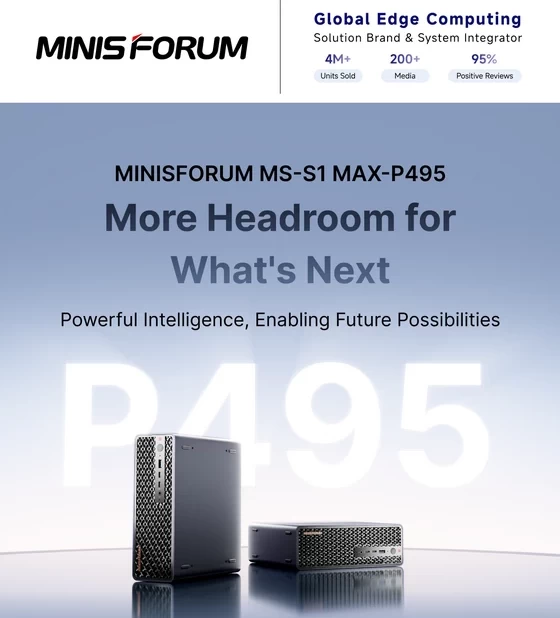
Presented under the slogan “More Headroom for What’s Next,” the MS-S1 MAX-P495 reflects an important change in the compact computer market. This is not simply another small Windows PC built to save space on a desk, but a genuine AI workstation conceived for tasks that would traditionally require a substantially larger tower, a dedicated graphics card and a much more complicated hardware configuration. Pricing has not yet been officially revealed, although MINISFORUM has opened an early-access registration program ahead of the launch, with limited initial availability and three complimentary accessories reserved for qualifying subscribers. MINISFORUM MS-S1 MAX-P495 official product page
AMD Ryzen AI Max+ PRO 495 at the Centre of the Experience
The foundation of the MS-S1 MAX-P495 is the AMD Ryzen AI Max+ PRO 495, a formidable all-in-one processor based on AMD’s latest-generation architecture and engineered to deliver high-end CPU, GPU and AI acceleration inside one closely integrated platform. Its 16 Zen 5 CPU cores and 32 processing threads can reach boost frequencies of up to 5.2GHz, giving the workstation the computational resources required for complex multitasking, software compilation, data analysis, virtualization, 3D production and other heavily threaded professional workloads.
Instead of treating artificial intelligence as a secondary feature, MINISFORUM has designed the entire machine around modern AI-assisted computing. The processor incorporates a dedicated next-generation NPU capable of delivering up to 55 TOPS, while the complete platform can reach as much as 131 TOPS of combined AI performance. This considerable reserve of local computing power can accelerate compatible language models, image-generation tools, voice applications, real-time inference, multimodal workflows and the expanding selection of professional software that can use dedicated AI hardware.
Local processing also offers advantages that go beyond headline performance. Sensitive documents, proprietary datasets and creative materials can remain on the workstation rather than being continuously uploaded to an external cloud service, while frequently used AI tools can respond without being entirely dependent on internet connectivity or remote server availability. For developers, researchers and businesses, this combination of performance, privacy and predictable access may prove to be one of the MS-S1 MAX-P495’s most valuable characteristics.
Radeon 8065S Graphics Without a Conventional Dedicated GPU
Graphics performance is handled by AMD Radeon 8065S integrated graphics, based on the RDNA 3.5 architecture and equipped with 40 graphics cores operating at up to 3000MHz. Although it forms part of the Ryzen AI Max+ PRO 495 platform rather than appearing as a separate graphics card, this is a significantly more ambitious solution than the modest integrated graphics traditionally associated with compact office computers.
The Radeon 8065S is intended to provide the acceleration required for video editing, GPU-assisted rendering, 3D visualization, AI image generation and other creative or technical applications, while the shared memory architecture allows it to access a much larger memory pool than a typical mobile graphics solution. MINISFORUM says that as much as 160GB of the available unified memory can be allocated as video memory, giving unusually demanding datasets and models considerably more room to operate.
This architecture does not make the system a universal replacement for every high-end workstation equipped with a discrete professional GPU, but it creates a compelling alternative for users whose workloads benefit more from a vast shared memory pool, tight CPU-GPU integration and compact dimensions than from the specialized advantages of a conventional graphics card.
Up to 192GB of High-Speed Unified Memory
Memory capacity is one of the defining features of the MS-S1 MAX-P495. The workstation supports up to 192GB of LPDDR5x memory operating at speeds of up to 8533MT/s through a 256-bit unified memory architecture. Rather than dividing system memory and graphics memory into rigidly separated pools, this design allows the CPU, integrated graphics and AI engines to work with the same high-capacity memory resources.
Reducing unnecessary movement of data between separate memory pools can improve efficiency and decrease latency, especially when running large AI models or manipulating complex media projects. MINISFORUM says the workstation is capable of running large language models with as many as 300 billion parameters locally, although practical performance will naturally depend on the model, quantization level, software framework and selected configuration.
For creative professionals, this memory architecture also opens the door to more demanding video timelines, detailed 3D scenes, large photographic projects, AI-generated artwork and audio-production sessions without the restrictive memory ceiling commonly encountered on smaller systems. The appeal is not simply having an impressive number on a specification sheet, but having enough capacity to keep ambitious projects running locally as professional software and AI models continue to grow.
Designed for Sustained Professional Performance
High peak performance is useful only when a computer can maintain it, which is why MINISFORUM has equipped the MS-S1 MAX-P495 with a substantial cooling system built around a pure copper base, six heat pipes, dual turbine fans and advanced phase-change material. The cooling assembly is designed to support a stable 120W operating level and a short-term peak of 160W, helping the processor sustain demanding workloads while reducing the likelihood of performance being lost through thermal throttling.
Users can select among Performance, Balanced and Quiet operating profiles, while a dedicated Rack mode supports more specialized multi-system deployments. This flexibility allows the machine to adapt to different environments, ranging from a personal office or creative studio, where lower acoustic output may be preferred, to an intensive compute environment in which maximum sustained performance becomes the priority.
The workstation also incorporates an internal 320W high-efficiency power supply, eliminating the need for an oversized external power brick and contributing to a cleaner installation. The resulting machine measures 222.1 × 206.3 × 77.1mm and weighs approximately 2.8kg, making it substantially smaller than a traditional professional tower while remaining large enough to accommodate serious thermal management, storage and expansion capabilities.
A Distinctive Aluminum Workstation Chassis
The visual design communicates the MS-S1 MAX-P495’s professional intentions immediately. Its aerospace-grade aluminum enclosure combines a restrained dark finish with a prominent diamond-matrix grille that gives the front panel a technical, almost industrial personality while allowing the cooling system to draw and exhaust air efficiently.
The chassis can be positioned vertically to minimize its desktop footprint or placed horizontally for integration into a workstation arrangement. MINISFORUM has also designed it for 2U rack deployment, an unusual capability that substantially broadens its potential audience beyond individual enthusiasts. A slide-out internal board tray is intended to simplify maintenance and hardware access, making the machine more practical for professional environments in which systems must be serviced or reconfigured without unnecessary disassembly.
Despite its compact proportions, the MS-S1 MAX-P495 does not look like a decorative consumer mini PC. Its design suggests a small but purposeful piece of computing infrastructure, equally appropriate beside a monitor in a private studio or installed as part of a larger AI processing cluster.
Did this article help you? If so, please tell me in a comment what do you think about it.
Don’t miss any of our future video tutorials, follow us on Youtube. Like us on Facebook. Join our Best Deals Telegram Channel. Join our Android TV Box Firmware Updates Telegram Channel. Subscribe now to our newsletter. If you need Tech Reviewer or Youtube Influencer read this. Donate now here to support CGR Team!















